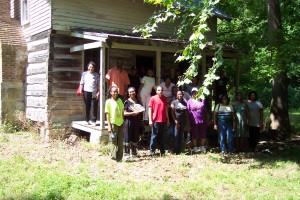
In addition to touring the grounds surrounding the Wessyngton mansion, National Black Arts Festival members and guests walked in the footsteps of Baker’s ancestor in the slave cabin area of the plantation. The group went inside a restored slave cabin built ca. 1830. In 1860, there were 274 enslaved African Americans on the plantation, housed in forty log cabins. At the onset of the Civil War, Wessyngton held the largest African American population in the state of Tennessee and was the largest tobacco producer in America.
Tags: African History, Antebellum Plantation, black history, Civil War, Dr. Collette Hopkins, National Black Arts Festival, plantation slavery, Plantations, Slave cabins, Slave Housing, Slave Labor, Slave Life, Southern Plantation, Tennessee slavery, Wessyngton mansion
Valuable info. Lucky me I found your site by accident, I bookmarked it.
Great information! I’ve been looking for something like this for a while now. Thanks!
I saw this really great post today!
I found an extract recently from the diaries of a plantation owner, William Byrd. Its not that he was brutal with his slaves that surprised me, it’s the matter of fact way he commented on it
“I rose at 5 o’clock this morning and read a chapter in Hebrew and 200 verses in Homer’s Odyssey. I ate milk for breakfast. I said my prayers. Jenny and Eugene [two house slaves] were whipped. I danced my dance [physical exercises]……My wife was indisposed again but not to much purpose. In the afternoon I beat Jenny [a house slave] for throwing water on the couch”.
Sexually assaulting women of the lower orders was no big deal to Byrd either;
“I rose at 6 o’clock and said my prayers and ate milk for breakfast. Then I proceeded to Williamsburg, where I found all well. I went to the capitol where I sent for the wench to clean my room and when she came I kissed her and felt her, for which God forgive me”.
Auron,
Most of the plantation diaries I’ve seen also record information in this fashion.